
Why Does My Cat Lick Me? Understanding This Common Feline Behavior
A cat lick often means your cat feels comfortable, connected, and engaged with you. This behavior typically reflects social bonding, grooming instincts, or communication. Cats use licking the same way they would with other cats in their social group, which means your cat likely sees you as part of their inner circle. While most licking is normal, the context and frequency can reveal whether it’s affectionate, attention-seeking, or linked to an underlying concern.
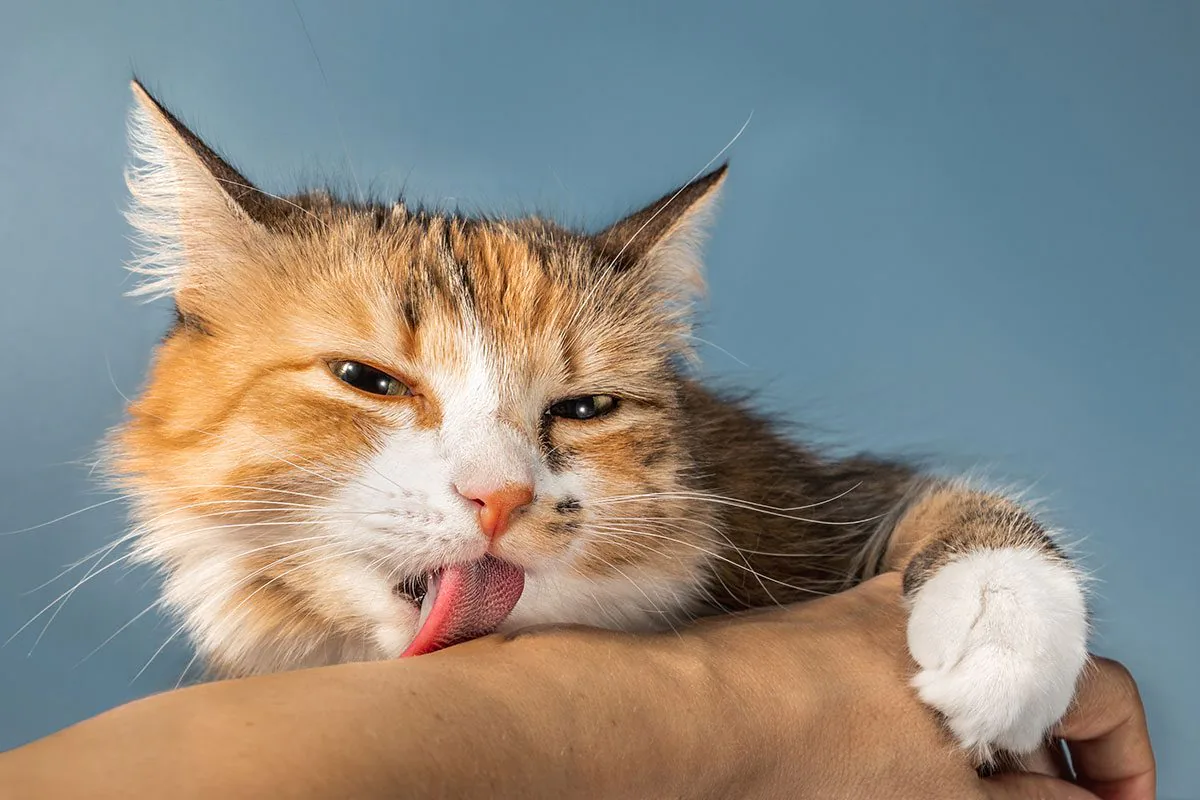
Why Does My Cat Lick Me When I Pet Her?
Many pet owners notice that cat lick behavior starts during quiet moments, especially while petting. This response connects closely to how cats build trust and reinforce relationships. When a cat begins licking during petting, they often respond to touch in a way that mirrors social grooming behaviors seen between cats.
Cats rely on grooming as both a hygienic habit and a social tool. In multi-cat households, bonded cats groom one another to strengthen their connection. When a cat extends this behavior to a person, she includes them in that same trusted group.
Common Reasons Cats Lick During Petting
- Social bonding: Your cat associates your presence with safety and comfort, so she responds with grooming behavior.
- Scent exchange: Cats use scent as a form of communication. Licking helps transfer their scent onto you, reinforcing familiarity.
- Positive reinforcement: If your cat enjoys being petted, licking may signal contentment and encourage continued interaction.
- Routine behavior: Some cats develop habits tied to specific activities, such as licking whenever they relax with their owner.
This behavior often feels reassuring to pet owners because it reflects trust. At the same time, you may notice that the licking becomes repetitive or intense. When that happens, it helps to evaluate whether your cat is simply engaged or trying to communicate something more.
What Does It Mean When a Cat Licks You?
A cat lick can carry several meanings depending on the situation. Understanding context helps clarify whether a cat is expressing affection, curiosity, or a need for attention. While many owners view licking as a sign of love, it can also serve practical and behavioral purposes.
Cats communicate through body language, vocalizations, and physical contact. Licking fits into this communication system and often overlaps with other behaviors like kneading, purring, or head-butting.
Possible Meanings Behind Cat Licking
- Affection and bonding: Licking mirrors the grooming behavior cats use with companions they trust.
- Attention-seeking behavior: Your cat may lick you to initiate interaction or redirect your focus.
- Taste and curiosity: Human skin can carry salt or scents that interest cats, prompting exploratory licking.
- Self-soothing behavior: Some cats lick as a way to calm themselves in new or stimulating environments.
In most cases, occasional licking remains harmless. However, if the behavior becomes excessive or paired with changes in appetite, grooming, or energy levels, we recommend scheduling an evaluation. Behavioral shifts can sometimes reflect stress or underlying medical concerns.
Why Does My Cat Bite Me Then Lick Me?
The combination of a cat biting and then licking can feel confusing. Many pet owners interpret this behavior as mixed signals, but it often reflects overstimulation or a shift in a cat’s comfort level. Cats have a threshold for touch, and once that threshold is reached, they may respond with a gentle bite followed by licking.
This sequence does not necessarily indicate aggression. Instead, it often represents a communication pattern where a cat attempts to regulate the interaction.
Why Cats Bite Then Lick
- Overstimulation: Repetitive petting can become overwhelming, leading to a quick bite as a signal to pause.
- Play behavior: Some cats incorporate gentle bites into play, followed by licking as part of the interaction.
- Redirected grooming: After a bite, your cat may instinctively return to grooming behavior.
- Boundary setting: The bite communicates a limit, while the lick softens the interaction.
You can often reduce this behavior by watching your cat’s body language. Signs such as tail flicking, ear rotation, or muscle tension often appear before a bite. Adjusting your interaction at these early cues can help keep the experience positive.
When a Cat Lick May Signal a Concern
While most cat lick behavior remains normal, certain patterns may suggest that a cat needs veterinary attention. Cats often mask discomfort, so subtle changes in grooming or interaction can provide important clues.
Excessive licking, especially when directed toward people, objects, or themselves, may reflect stress or physical discomfort. Environmental changes, new pets, or shifts in routine can also influence behavior.
Signs That Warrant a Veterinary Visit
- Compulsive licking: Repetitive licking that seems difficult for your cat to stop
- Skin irritation or hair loss: Areas of thinning fur or redness
- Behavior changes: Increased hiding, vocalization, or reduced interaction
- Sudden increase in licking behavior: A noticeable shift from your cat’s normal habits
In these situations, your veterinarian will evaluate both behavioral and physical factors. Their goal is to identify what may be driving the change and guide you toward appropriate next steps.
How Veterinarians Evaluate Changes in Cat Behavior
When clients ask why a cat licks more than usual, veterinary teams take a comprehensive approach. They review medical history, daily routine, and environment to understand the full picture. Behavior rarely exists in isolation, so patterns over time guide evaluation.
Your team may discuss factors such as diet, activity level, household changes, and interactions with other pets. They also perform a physical examination to rule out underlying medical conditions that may contribute to increased licking.
By combining behavioral insight with medical evaluation, your veterinarian can help determine whether a cat’s licking reflects a personality trait or signals a concern that needs attention.
Support Your Cat’s Behavior with Guidance from Schertz Animal Hospital
If you have questions about your cat’s behavior or notice changes in how often cat lick patterns occur, our team at Schertz Animal Hospital is here to help. We work with pet owners throughout Schertz, TX, to better understand feline behavior and support long-term health.
Call (210) 659-0345 or request an appointment online to speak with our team about your cat’s behavior. Together, we can help you better understand what your cat is communicating and how to respond with confidence.
Recent Posts
About Us
We know that choosing the right veterinarian for your pet (and you) can be a challenge. Yet, with our stress-free handling, our long-term, experienced staff, and a state-of-the-art facility, we make the decision an easy one!